1–16mm² Copper Cable Factory Configuration Guide:
From soft-conductor bunching and double-layer insulation extrusion to multi-core cabling and sheathing: a process route, equipment list, and procurement checklist for new and expanding factories.
Contents:
This guide takes a copper wire equipmentlist as a sample, breaks down the process routes for single-core, 2-core,
3-core, 4-core and 5×16 products, and analyzes whether the equipment configuration is reasonable, what to watch for in the quotation wording, and what additional steps a new factory must complete before becoming operational.
Reading Guide:
01 Product & Process Scope — Conductor cross-sections,core-count combinations and their applications.
02 Equipment List Analysis — The function, applicable cross-section andinterfaces of the five core machine types.
03 Budget & Procurement Terms — Total price, reel accessories,validity, payment and lead time.
04 DeploymentChecklist — Testing, workshop, power, personnel andsupplier review items.
Note: The “applicable cross-section” stated inthe equipment list is the supplier’s description of a typical adaptation range;
it is not a national or industry standard cross-section definition. Procurement decisions should still be based on sample trial results, finished-product test reports and the standards of the target sales market.
Who this guide is for:
1.Entrepreneurs setting up smalland medium-sized copper wire factories for building wires, power cords,electronic wires and shielded wires;
2. Production managers preparing to expand to 16mm² or add multi-core cabling capability;
3. Procurement teams responsible for equipmentinquiry, technical review and supplier price comparison.
What products does thislist mainly cover?
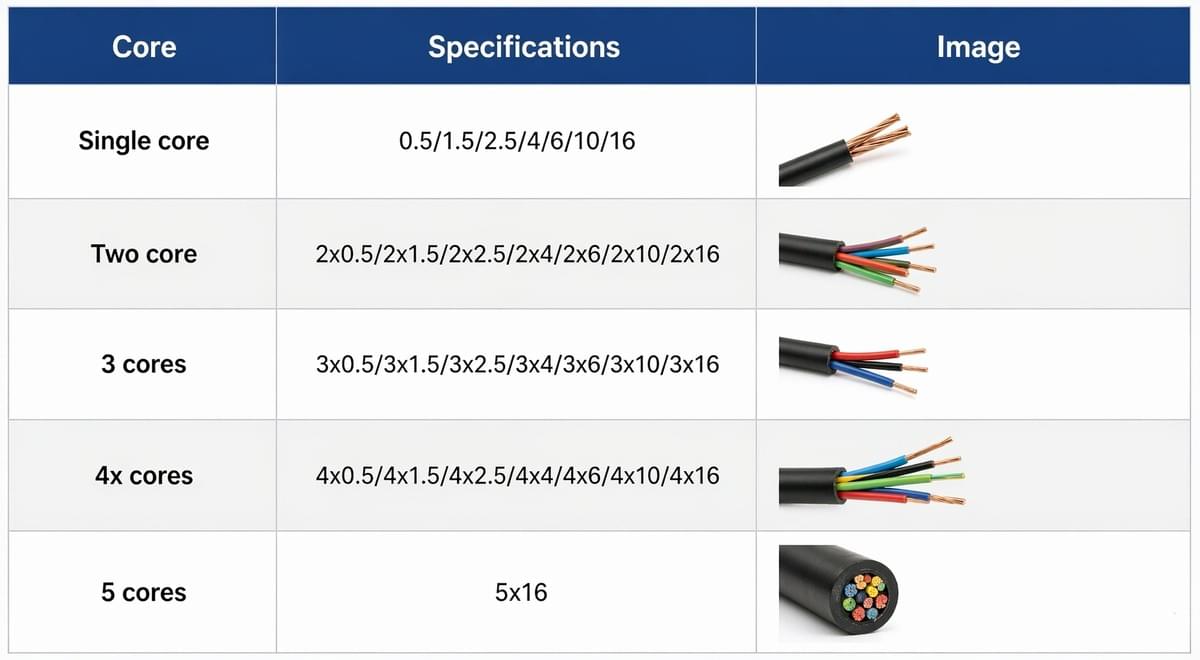
The list covers single-core 0.5, 1.5, 2.5, 4, 6, 10,16 mm², as well as equal-cross-section 2-core, 3-core and 4-core structures,extendable to 5×16. Applicable products include mobile phone cables, building wires, computer cables, power cords, plug cores, earphone cables, RVB cables and shielded wires.
Process Route
How is a cable“twisted” into shape?
1.Conductor preparation
Bunch-strand single copper wires into asoft, dimensionally stable conductor according to process requirements.
Cross-sections of 0.5–6 mm² favor finer soft conductors, while 6–16 mm² correspond to larger bunching capacity.
2.Insulation extrusion
Continuously extrude a PVC insulation layerover the conductor, then form an individual insulated core through cooling,
diameter gauging, spark testing and printing.
3.Multi-core cabling
Twist multiple insulated cores into a cablecore according to lay length, lay direction and arrangement requirements. The
large outer-diameter structure of 5×16 is the focus of this stage.
4.Sheath application
Extrude an outer sheath over the cable coreto form a wear-resistant, environmentally resistant and identifiable multi-core
finished cable.
5.Inspection & packaging
Measure diameter, eccentricity, conductorresistance, and insulation & sheath properties, then coil, reel or package according to order requirements.
Where the listedequipment fits:
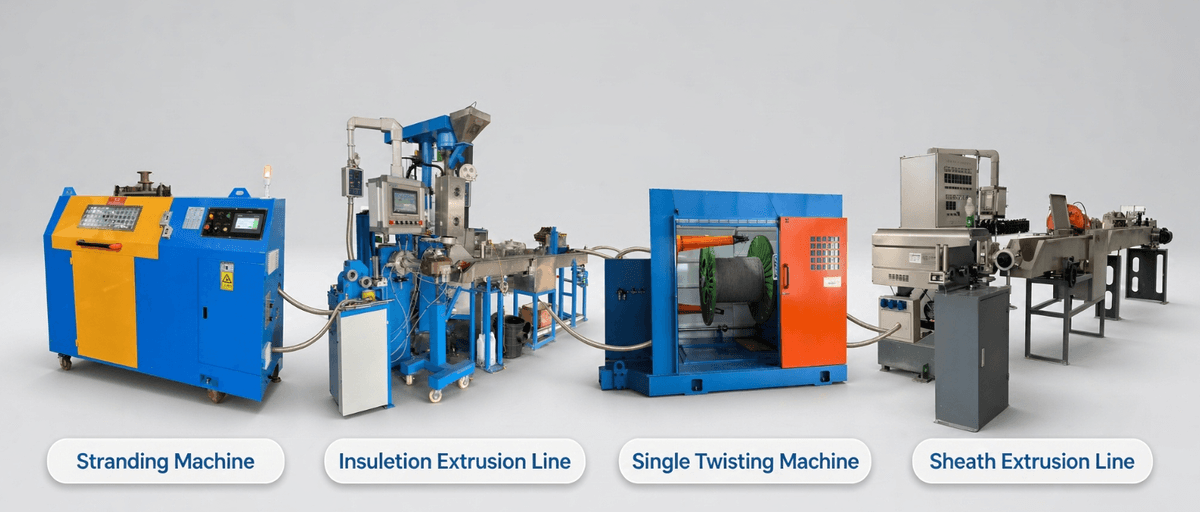
The 630 and 1000 bunching machines handleconductor stranding; the 70+50 double-layer insulation line handles insulation extrusion; the 1250 cantilever single-twist machine handles multi-core cabling; and the 90/25 sheathing line handles the outer sheath. Together they form the main line from “copper wire” to “finished cable”.
02 Equipment List
Bunching & Double-Layer Insulation Equipment
1. 630 Bunching Machine— covers 0.5–6 mm² soft conductors
Used to bunch multiple copper wires into asoft conductor, suitable for fine wires, electronic wires, power-cord cores and
smaller cross-section soft conductors. Its value lies in ensuring stable lay pitch, smooth surface and conductor structure consistency.
2. 1000 BunchingMachine — covers 6–16 mm² conductors
Designed for larger cross-sectionconductors, it forms a fine/coarse split with the 630 machine. For 10 and 16mm² conductors, the larger reel diameter and bunching capacity help control wire arrangement, tension and production continuity.
3. 70+50 Double-LayerInsulation Line — the main line
The 70 main machine combined with the 50auxiliary machine can be used for double-layer insulation and colored-stripe
structures. The list states that the 70+50 can produce 0.75–10 mm² and the 50 machine can produce 0.5–6 mm². It determines the insulation thickness,eccentricity and appearance quality.
Cantilever single-twist machines arecommonly used for multi-core wire stranding; larger cross-section cable cores
impose higher requirements on reels, tension and roundness.
Procurement priority:when trial-running, do not only ask “can it be made”; also confirm the maximum
stable speed, insulation thickness control, color and specification changeovertime, mold configuration and temperature-control stability during continuous operation.
Cabling & Sheathing Equipment
4. 1250 CantileverSingle-Twist Machine — multi-core cabling
Used to twist 2-, 3-, 4- and 5-coreinsulated wires into a cable, especially suitable for larger outer-diameter structures such as 5×16. The selection should simultaneously verify the single-wire diameter, cabled outer diameter, take-up reel size and lay-pitch range.
5. 90/25 Sheathing Line— completes the outer sheath
Extrudes PVC or other sheathing materialover the cabled core; the list indicates an applicable outer diameter of approximately 8–55 mm. It is an indispensable part of producing multi-coresheathed wires, power cords and control cables.
Cabling interface: the pay-off tension of theinsulated cores before the cantilever single-twist machine, center filling and
tape-wrapping configuration often determine the roundness of the finished
product. If the product requires filling, taping or shielding, whether the
relevant tooling is included should be stated clearly in the contract.
03 Eight questions toconfirm before delivery:
1.What exactly is included with the equipment?
Main machine, electrical cabinet, molds,pay-off/take-up, cooling system, spark tester, diameter gauge, printer, meter
counter, spare parts, etc. — list item by item.
2.Who is responsible for trial running and acceptance?
Clarify trial materials, wire types,specifications, speed, qualified samples and acceptance documents.
Responsibilities for rectification if acceptance is not passed must be written
out.
3.Does the power supply and foundation match?
Check total power, compressed air, coolingwater, workshop height, door width, foundation load and crane capacity.
4.Are languages and documents complete?
Require English or Chinese operationmanuals, electrical drawings, spare-parts list, warranty scope and after-sales
response time.
04 Deployment Plan
From Contract Signing to Production
Day 1–30 | Contract & workshop preparation
Fix the product first, then the equipment.Complete product standards, capacity calculations, equipment technical
agreement, workshop power, cooling, fire protection, logistics access and
foundation plan.
Day 31–90 | Manufacturing & review
Procurement runs in parallel withmanufacturing. After paying the deposit, track manufacturing milestones and
review key-component brands, electrical-control scheme, safety interlocks,
spare parts and packaging.
Day 91–120 | Pre-acceptance & dispatch
Use samples to verify capability. Trial-runsample wires, check diameter, eccentricity, appearance, speed, take-up and
continuous-operation performance, then arrange packaging, transport and
loading.
After arrival | Installation, commissioning & training
Turn equipment into stable capacity.Complete mechanical installation, electrical connection, parameter tuning,
operator training, process documentation, first-article inspection and
continuous-production verification.
Stable production | Inspection & market access
Quality is the premise of repeat orders.Establish incoming inspection, in-process inspection, finished-product testing,
equipment maintenance, mold management and nonconforming-product traceability
systems.